Design Systems for Small Teams: Why They Save Time
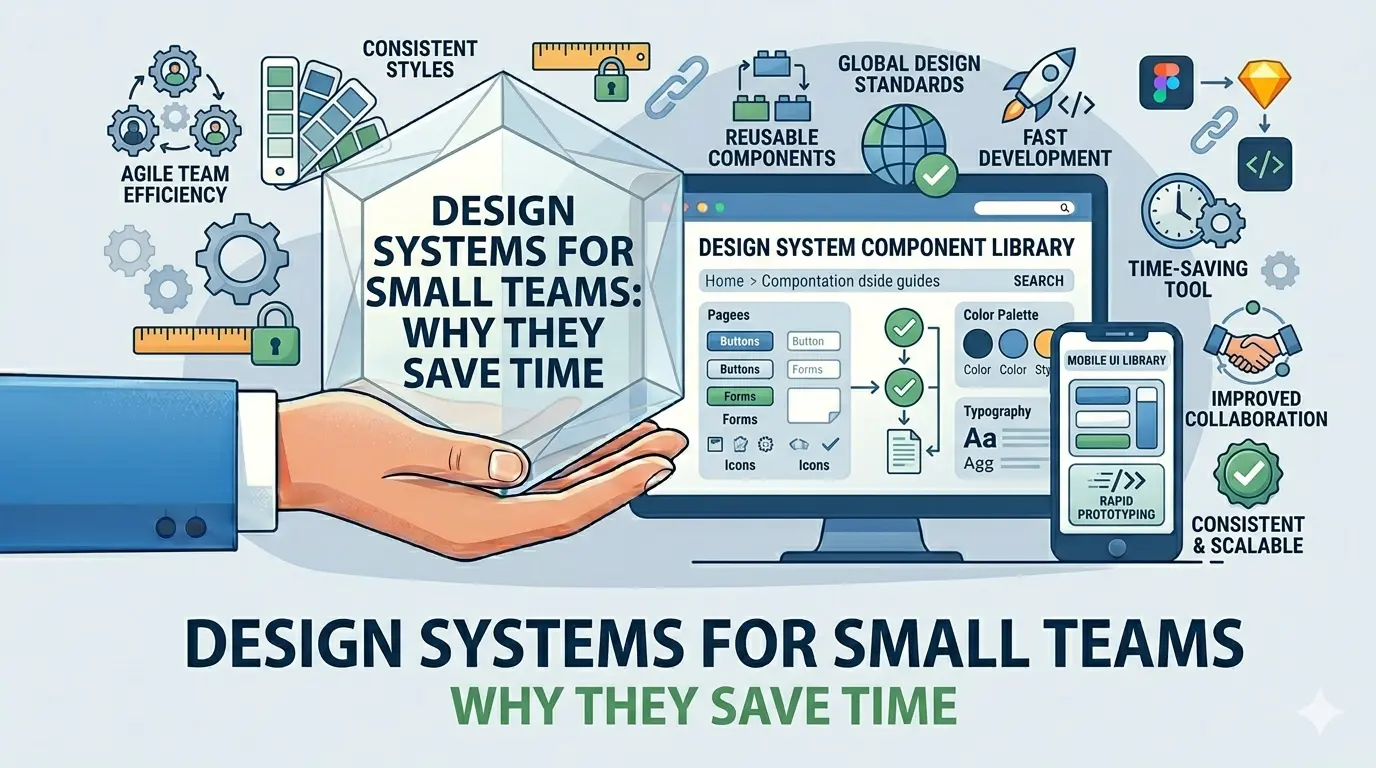
Even lightweight design systems improve speed, consistency, and confidence across marketing and development updates.
Consistency reduces decision fatigue
Without a design system, teams redesign common UI patterns repeatedly. This wastes time and introduces visual inconsistency. A lightweight system creates shared rules for typography, spacing, colors, and component behavior.
Start small
Document buttons, cards, form controls, and page section templates first. These components generate most interface decisions and provide immediate leverage.
For small teams, design systems are not overhead. They are a productivity multiplier.
Strategic context
Teams that work on lightweight design systems usually focus on visible outputs first, but long-term performance depends on operational quality behind those outputs. Sustainable growth comes from repeatable process, clear ownership, and measurement discipline.
The practical objective is straightforward: improve speed, consistency, and maintainability. To achieve this consistently, execution must connect content, UX decisions, and technical reliability in one workflow.
Why many implementations underperform
Most underperformance is not caused by lack of effort. It is caused by fragmented decision making. One team updates design, another updates copy, and analytics is reviewed later without shared success criteria. This creates activity without dependable progress.
- Scope decisions are made without baseline metrics.
- Publishing cadence is inconsistent and reactive.
- User intent is assumed instead of validated with behavior data.
- Quality reviews happen after launch rather than before release.
Execution framework for the next quarter
- Phase 1 - Diagnose: define the primary conversion path and identify friction points with analytics and qualitative review.
- Phase 2 - Prioritize: select the smallest set of changes most likely to influence revenue-relevant behavior.
- Phase 3 - Implement: ship changes in controlled batches with clear owner accountability.
- Phase 4 - Validate: compare outcomes against baseline and record learnings for the next cycle.
- Phase 5 - Standardize: convert successful patterns into reusable templates and governance rules.
Quality standards worth enforcing
High-performing teams use simple, non-negotiable standards. These standards protect consistency and reduce review friction over time.
- Every major page has one clear primary action and supporting trust signals.
- Claims are backed by evidence, examples, or measurable outcomes.
- Mobile behavior is tested as a first-class experience, not a final check.
- Tracking events map to business actions, not vanity interactions only.
- Content updates include revision rationale and expected metric impact.
Operational cadence that prevents drift
Execution quality improves when review cadence is predictable. A monthly operating rhythm works for most service teams and small agencies.
- Week 1: analytics review and friction-point triage.
- Week 2: content and UX updates on high-intent pages.
- Week 3: technical quality checks and performance refinements.
- Week 4: sales/support feedback loop and next-cycle planning.
Measurement model
Use a mixed scorecard so decisions are based on outcomes, not assumptions.
- Conversion path completion rate.
- Qualified lead ratio or successful transaction ratio.
- Drop-off by step in the user journey.
- Average response time and operational handoff quality.
- User trust signals from feedback, repeat actions, and support quality.
Practical scenario
A team applied this model over one quarter and shifted from ad hoc fixes to outcome-led updates. The first improvements were modest, but consistency produced compounding gains: fewer wasted revisions, better message clarity, and stronger alignment between traffic sources and conversion pages.
Most importantly, cross-functional communication improved because each update was tied to a stated objective and measurable result.
Final guidance
For lightweight design systems, quality is not achieved through one major release. It is earned through disciplined iteration. When teams align content depth, technical execution, and operational review, results become more predictable and resilient.
If you need stronger performance, start by tightening process clarity and measurement consistency. Those two changes usually unlock better outcomes faster than adding new tools.
Operational addendum 1: document decision assumptions, validate analytics integrity, align page messaging with user intent, and review outcomes against business goals every month. This prevents performance drift and keeps execution quality stable.
Operational addendum 2: document decision assumptions, validate analytics integrity, align page messaging with user intent, and review outcomes against business goals every month. This prevents performance drift and keeps execution quality stable.
Operational addendum 3: document decision assumptions, validate analytics integrity, align page messaging with user intent, and review outcomes against business goals every month. This prevents performance drift and keeps execution quality stable.
Operational addendum 4: document decision assumptions, validate analytics integrity, align page messaging with user intent, and review outcomes against business goals every month. This prevents performance drift and keeps execution quality stable.
Operational addendum 5: document decision assumptions, validate analytics integrity, align page messaging with user intent, and review outcomes against business goals every month. This prevents performance drift and keeps execution quality stable.
Operational addendum 6: document decision assumptions, validate analytics integrity, align page messaging with user intent, and review outcomes against business goals every month. This prevents performance drift and keeps execution quality stable.
Operational addendum 7: document decision assumptions, validate analytics integrity, align page messaging with user intent, and review outcomes against business goals every month. This prevents performance drift and keeps execution quality stable.
Operational addendum 8: document decision assumptions, validate analytics integrity, align page messaging with user intent, and review outcomes against business goals every month. This prevents performance drift and keeps execution quality stable.
Operational addendum 9: document decision assumptions, validate analytics integrity, align page messaging with user intent, and review outcomes against business goals every month. This prevents performance drift and keeps execution quality stable.
Operational addendum 10: document decision assumptions, validate analytics integrity, align page messaging with user intent, and review outcomes against business goals every month. This prevents performance drift and keeps execution quality stable.
Ready to build something great?
Let's turn your idea into a powerful digital product. Get a free consultation today.